
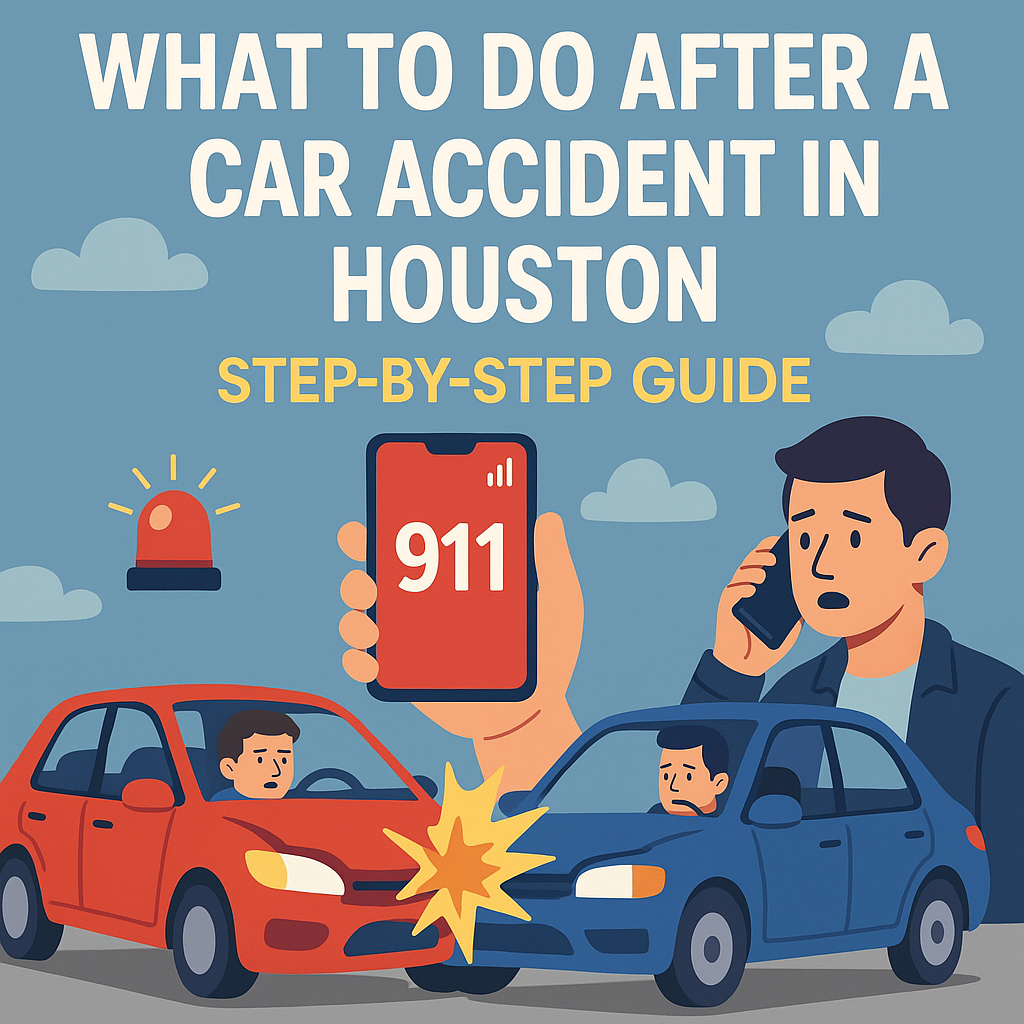
A serious car accident is disorienting. In those first moments after a crash, what you do can affect your safety, your medical outcome, and your legal rights. This guide walks you through what to do—step by step—if you’re ever involved in a car accident in Houston. It’s tailored for Texas law, and includes real stories, case law, and a downloadable checklist (free) branded with the Manuel De Santiago Law Group to help you stay organized when adrenaline is high.
Why This Matters: The Stakes Are High in Houston
- In 2023, Houston recorded 67,644 total crashes, including 274 fatal crashes and 1,360 suspected serious crashes. Fibich Leebron Copeland & Briggs+1
- In the same year, over 9,000 reported crash injuries occurred in Houston. Fibich Leebron Copeland & Briggs
- Houston’s roads see, on average, 160 to 180 accidents per day—that’s nearly one crash every 10 minutes. Sutliff & Stout Law Firm+1
- Tragically, more people currently die on Houston roadways than by homicide in recent years. Axios
These numbers remind us that crashes are not rare—they’re sadly common in Houston. You can’t predict them, but you can be prepared. Knowing exactly what to do can preserve evidence, protect your health, and help secure your rights.
True Story: The Turning Loop Crash
In 2024, a semi-truck rollover closed all eastbound lanes of Route 290 in Waller County. Houston Chronicle That accident, in proximity to Houston, created a cascade of collisions, backups, and confusion. Emergency crews had to coordinate quickly, and many drivers reported confusion over who was at fault, which vehicles were involved, and where witnesses were. That day illustrated one principle clearly: in chaotic scenes, methodical steps protect you.
Step-by-Step: What to Do Immediately After a Houston Car Crash
Below is a stepwise guide. You should also download our free printable checklist (PDF) with a branded logo from Manuel De Santiago Law Group to keep in your glove compartment or phone.
1. Stay Calm & Ensure Safety
- Don’t immediately bolt from your car or start yelling. Take a breath to assess your situation.
- If it’s safe, move vehicles out of traffic or to the shoulder; turn on hazard lights.
- If you or others are seriously injured, do not move unless staying put causes further danger (fire, explosion, etc.).
2. Call 911 Immediately
- Report the crash. Tell the dispatcher: your location, number of vehicles, if anyone is injured.
- Request ambulances if needed.
- Ask a police officer to come to the scene. In Texas, law enforcement may attempt to respond depending on severity, damage, and injuries.
3. Document the Scene (Photos, Notes, Witnesses)
While waiting:
- Use your phone to take wide-angle and close-up photographs. Capture vehicle positions, damage, skid marks, debris, road signs, intersections, traffic signals, vehicle identification (VIN, license plates), and relevant surroundings (trees, buildings, lighting).
- If possible, record video (slow pan) of the entire intersection.
- Note the date, time, weather, lighting, traffic conditions.
- Talk to witnesses: get names, phone numbers, and a brief statement (if willing). Ask what they saw.
- Do NOT apologize or take blame on scene—anything you say might later be construed as an admission of fault.
4. Exchange Information
Between drivers:
- Names, addresses, phone numbers
- Driver’s license numbers
- Insurance companies and policy numbers
- Vehicle make, model, year, color, license plate
- If applicable, contact info for vehicle owner (if different)
- If there are passengers or independent parties (bicyclists, pedestrians), note their info
5. Seek Medical Attention Promptly
- Even if you feel “okay,” some injuries (e.g. internal trauma, whiplash, concussion) may show symptoms hours or days later.
- Go to the ER or urgent care, following police or EMS guidance.
- Be sure to get all medical records, diagnoses, imaging reports, bills. These become essential later.
6. Report the Crash to Texas Authorities
Texas law requires you to file a crash report if:
- There is an injury or death; or
- Property damage exceeds $1,000.
Failing to report can complicate your claim. Your attorney can help you with this and ensure deadlines are met.
7. Preserve Evidence & Don’t Alter the Scene
- Save all photographs and videos.
- Keep your vehicle, as is, until your attorney or an expert inspects it (don’t repair it prematurely if possible).
- Retain any surveillance footage (from nearby cameras or dashcams). Request copies quickly—these often get overwritten.
- Save all receipts, invoices, correspondence.
8. Avoid Giving Recorded Statements to Insurers
- Insurance adjusters may contact you and request a recorded statement. Don’t agree to talk without your attorney.
- Be cautious in conversations: stick to facts (where you were, what you saw), do not guess, do not volunteer statements like “I think I might have been speeding.”
9. Contact an Experienced Houston Car Accident Attorney
- Do this as soon as possible (ideally within 24–72 hours).
- An attorney will:
- Investigate liability (accident reconstruction, witness interviews)
- Gather medical and repair evidence
- Handle all communication with insurance companies
- Calculate a fair demand for injuries, lost wages, property damage
- File suit (if necessary) before the Texas statute of limitations expires
In Texas, you generally have two years from the crash date to file a personal injury lawsuit. (See Tex. Civ. Prac. & Rem. Code § 16.003.)
10. Stay Engaged & Document Ongoing Effects
- Continue to follow your doctor’s treatment plan. Attend follow-up visits.
- Track everything: physical therapy, medication, lost wages, pain and suffering, emotional distress.
- Save appointment notices, prescriptions, receipts, travel logs.
- Don’t settle prematurely. Wait until your recovery plateaus (called “maximum medical improvement”) so you can account for long-term effects.
True / False: Common Myths About Car Crashes in Texas
| Statement | True or False | Explanation |
|---|---|---|
| “If I feel fine, I don’t need medical treatment.” | False | Some injuries (e.g. internal bleeding, concussions) show delayed symptoms. Medical records create utility evidence for your claim. |
| “I can’t afford a lawyer, so I’ll just deal with insurance myself.” | False | Many personal injury lawyers work on contingency fee (no payment until you win). You should let a lawyer handle insurance negotiation. |
| “If the police don’t show up, I’m screwed.” | False | You can still collect evidence, file your report, and your attorney can move forward without a police crash report. |
| “The insurance company’s first offer is fair.” | False | Insurers often aim low, hoping you’ll accept quickly. Don’t accept until an attorney reviews. |
| “I have two years to do anything I want.” | False (mostly) | Yes, you usually have two years to file suit, but certain aspects (e.g. filing crash report, notifying insurer, preserving evidence) must be handled faster. |
Case Law Example: Liberty Mut. Ins. Co. v. Akers
In Liberty Mut. Ins. Co. v. Akers, 607 S.W.2d 574 (Tex. Civ. App. — Tyler 1980, writ ref’d n.r.e.), the court emphasized that an insured’s delay in reporting a claim to the insurer could prejudice the insurer’s ability to investigate, leading to a possible defense by insurers. While this case is older, its principle holds: prompt reporting and cooperation protect your rights.
Another relevant case: Gulf Ins. Co. v. Rushing, 41 S.W.3d 596 (Tex. App.—Dallas 2001, pet. denied) reminds us that failure to preserve critical evidence may lead to adverse inference or weakening of your claim.
These cases highlight why every step—reporting, documenting, preservation—is legally meaningful, not just procedural.
Quote from Manuel De Santiago
“In the moments after an accident, your choices don’t just affect your health—they shape your case. That’s why we encourage our clients to act deliberately, document carefully, and call us without delay.”
— Manuel De Santiago, Manuel De Santiago Law Group
We include that quote not just for inspiration but as a reminder: acting thoughtfully is your first legal move.
Downloadable Free Checklist
We’ve created a free downloadable checklist (PDF) branded with the Manuel De Santiago Law Group logo. It outlines what to do at the scene, what evidence to gather, medical & legal follow-up steps, and timing reminders.
You can get a copy at Download Visual Checklist or Download Text Only Checklist and print it or save it to your phone. Carry a digital or physical copy in your glove box so in a stressful moment, you know exactly what to check.
Why You Need a Houston Car Accident Lawyer
- Insurance companies have legal teams; you deserve the same.
- Evidence deteriorates or vanishes (accident site changes, cameras overwrite, witnesses move).
- Complex Texas rules and case law—you need someone who knows local courts, statutes, and insurers.
- Maximize your recovery—attorneys know how to present damages for medical care, future costs, lost wages, pain and suffering, and punitive damages if applicable.
- You avoid costly mistakes—premature settlement, missing deadlines, saying the wrong thing to adjusters.
At Manuel De Santiago Law Group, we represent clients injured in motor vehicle accidents in Houston with passion, experience, and integrity. We handle the legal burden so you can focus on recovery. Contact us for a free consultation—we take most cases on a contingency basis (you pay nothing unless we win).
Take Action After a Houston Car Accident
Every minute counts after a crash. Evidence fades, memories blur, and deadlines approach quickly. Don’t wait to protect your rights — let Manuel De Santiago Law Group handle the legal side so you can focus on healing.
Call us today at (832) 356-3877 or visit www.manuellawyers.com to schedule your free consultation.
Our experienced Houston car accident lawyers are ready to guide you step-by-step, fight for your compensation, and ensure your voice is heard.
Download your free “Houston Car Accident Checklist” to keep in your car or phone — because knowing what to do next can make all the difference.
Final Notes
- Keep your checklist accessible.
- A calm, step-by-step approach after a crash can prevent permanent mistakes.
- Time matters—statutes, report deadlines, evidence retention all depend on swift action.
Stay safe, document carefully, and know your rights. When the unexpected happens, you don’t have to go through it alone—reach out.